As the warmer weather arrives, roads and boat ramps become increasingly busy. Anglers, water sports enthusiasts, and vacationers are eager to get their boats and personal watercraft into the water. However, towing a boat or a heavy trailer is not just about hitching up and hitting the road. It is a technically demanding process that requires an understanding of physics, mechanics, and road safety. At RS Pro Auto, our experts encounter situations daily where improper load securing or incorrect driving dynamics lead to costly repairs or even accidents. In this article, we will cover everything you need to know to ensure your towing journey is safe for you and everyone else on the road.
1. The Critical Factor: Tongue Weight
One of the most common mistakes drivers make is incorrect weight distribution on the trailer. Tongue weight is the force exerted by the trailer’s coupling onto the vehicle’s hitch. If this weight is too light or too heavy, the vehicle’s handling will suffer dramatically.
Too little tongue weight: If the cargo (e.g., boat engine and fuel tanks) is positioned too far toward the rear of the trailer, the hitch will tend to lift upwards. This creates instability, and at higher speeds, the trailer may begin to sway side-to-side, a phenomenon known as “snaking.” This is extremely dangerous and can cause the entire rig to overturn.
Too much tongue weight: If the boat is positioned too far forward, the rear of the vehicle becomes excessively loaded. This lifts the front axle, impairing steering control and reducing the front tires’ grip on the road, which is critical during braking.
Expert Tip: The ideal tongue weight is typically 5% to 10% of the total weight of the trailer and its cargo. Most passenger vehicle tow bars are designed for a maximum vertical load between 50 and 85 kg. You can easily check this using standard bathroom scales under the jockey wheel while the trailer is in a level position.
2. Safety Cables: Your Last Line of Defense
The safety cable is not just a decorative element or a formality for vehicle inspections. Its purpose is to engage the trailer’s emergency brakes (if equipped with inertia brakes) or to keep the tongue attached to the car should the coupling mechanism unexpectedly fail.
Many drivers make the mistake of simply looping the cable over the tow ball. The correct method is to attach the cable end to a specifically designated eyelet or hole on the hitch assembly. If the cable is just looped over the ball, it may slip off if the hitch disconnects, rendering it useless. Ensure the cable is not so tight that it restricts turning, but not so loose that it drags on the asphalt.
3. Lighting and Electrical Connection Nuances
Boat trailers face a unique risk: water. Even if you have modern, waterproof LED lights, saltwater or even freshwater can cause corrosion in the socket and plug. Before every trip, check the following:
- Do all turn signals and brake lights work correctly?
- Is there any visible green corrosion (oxidation) in the socket pins?
- Is the wiring harness damaged or pulled away from the connection points?
If you notice lights flickering or shining dimly, the culprit is likely a poor ground connection. Use specialized contact cleaner sprays to keep the system in working order. Remember, a poorly illuminated trailer in the dark or rain is a direct threat to your safety and the safety of others.
4. Technical Condition: Bearings and Tires
Boat trailer bearings take the most abuse because they are regularly submerged to launch the boat. Hot bearings meeting cold water create a vacuum, sucking moisture inside, which leads to rust and premature failure.
Before the season, lift the trailer with a jack and rotate the wheels. If you hear grinding or feel play (wobble), the bearings must be replaced immediately. Also, check tire pressure; trailer tires usually require higher pressure than those on passenger cars (refer to the manufacturer’s manual). Old, cracked trailer tires are a ticking time bomb, as they are often neglected for years even if the tread looks new.
5. Driving Dynamics: Cornering and Braking
Towing requires a complete change in your driving habits. Your vehicle assembly is now significantly longer and heavier.
- Cornering: Trailer wheels always follow a tighter radius than the car’s wheels. This means you must take corners “wider” to ensure the trailer doesn’t ride over curbs or into ditches.
- Braking Distance: Even with inertia brakes, a trailer significantly increases your stopping distance. Maintain at least double the distance from the vehicle in front.
- Overtaking: Avoid overtaking unless absolutely necessary. Acceleration will be slow, and returning to your lane requires much more space to ensure the trailer’s rear doesn’t clip the overtaken vehicle.
What to do if a breakdown occurs?
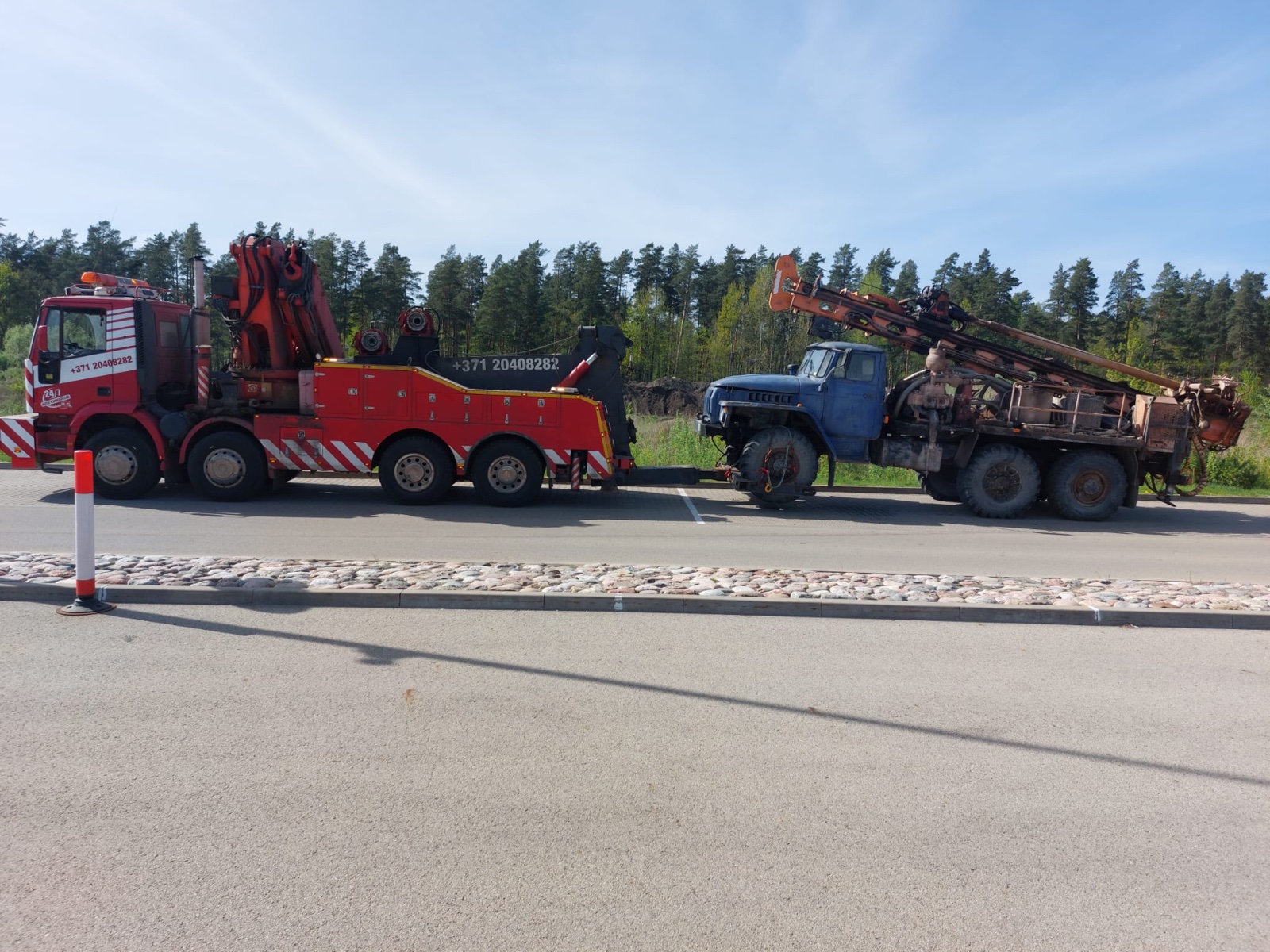
Even the most experienced drivers can face unforeseen situations—a flat tire, a broken trailer axle, or an engine fault. In these moments, professional help is vital. RS Pro Auto offers specialized non-standard towing services specifically suited for situations where both the vehicle and the trailer must be recovered.
When planning your budget, know that our towing service prices are transparent and predictable. Standard recovery within Riga usually costs 40-50 EUR, while mobile tire service starts from 40 EUR. We have the specialized equipment required to safely load and secure both boats on trailers and the trailers themselves if they have a damaged chassis.
Conclusion
Safe towing starts with preparation at home. A checked tongue weight, a properly secured safety cable, and working lights are the foundation to ensure your trip to the water doesn’t end on the side of the road. Remember: on the road, you are responsible not only for yourself but also for your cargo, which can become a dangerous projectile if an accident occurs. Drive carefully, choose an appropriate speed, and if trouble strikes, trust the professionals at RS Pro Auto!